
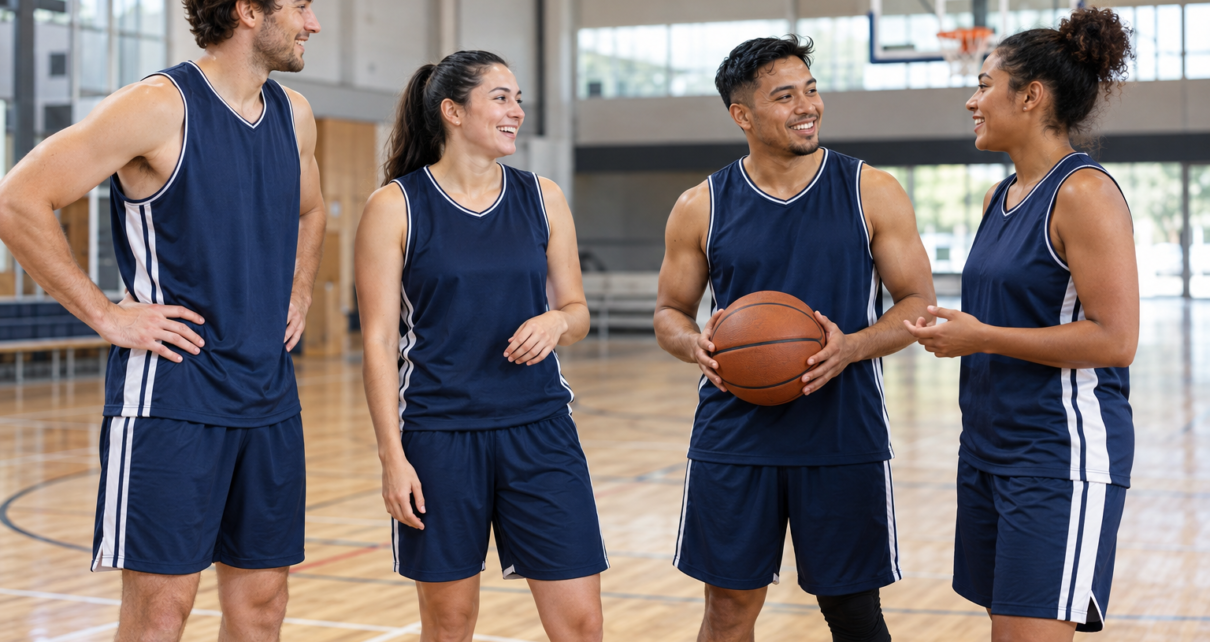
Organising a basketball uniform order involves more than choosing colours and adding a club logo. Team managers also need to account for player measurements, number allocations, design approval and replacements throughout the season. For clubs comparing basketball uniforms melbourne options, a clear ordering process helps turn those decisions into a coordinated set of jerseys and shorts that players can wear comfortably on court.
Start With the Team List and Competition Requirements
A reliable order begins with an accurate player list. Before requesting a quote, the organiser should record each player’s name, preferred number, jersey size and shorts size. Keeping these details in one document reduces the risk of information being lost across emails and group messages.
Number allocation needs particular attention. Two players may request the same number, while a returning player may expect to keep their previous one. Resolving these conflicts before artwork is prepared avoids unnecessary revisions later.
The club should also check the relevant competition requirements before approving a design. These may cover playing numbers, colour clashes, matching garments or other presentation details. Asking the competition organiser directly is more dependable than assuming that a design accepted elsewhere will meet local requirements.
For clubs with several teams, a consistent approach makes administration easier. A shared design can support a recognisable club identity, while a central number register helps manage players who move between squads.
Use Measurements Instead of Everyday Clothing Sizes
A player’s usual T-shirt size is only a starting point. Garment cuts and size labels vary, so measurements should be checked against the supplier’s current chart.
It is useful to establish whether the chart describes body measurements or finished garment measurements. Confusing the two can produce an order that is noticeably tighter or looser than expected. Where samples are available, a fitting session gives players a more practical way to assess their options.
Fit should be checked through movement. Players can raise their arms, bend their knees and adopt a defensive stance to see whether the jersey or shorts restrict them. Shoulder openings, garment length and waistband comfort all deserve attention.
Junior sizing requires a balanced decision. Some room for growth may be sensible, but excessive length or loose fabric can make clothing awkward during play. Recording separate sizes for jerseys and shorts also avoids assuming that every player needs matching labels in both garments.
Assess Fabric, Construction and Design Together
Fabric descriptions are easier to evaluate when supported by a physical sample. Players and organisers can assess weight, texture and stretch more confidently by handling the material than by relying on a photograph alone.
Construction matters just as much as appearance. Seams, armholes and waistbands should feel comfortable, and the garment should allow the movements expected during training and competition. Clubs can also request care instructions before ordering to understand the washing routine involved.
Design decisions should prioritise clear identification. Numbers need to remain easy to distinguish against the background, and decorative patterns should not overwhelm them. Logos and sponsor artwork should be supplied in the file format requested by the manufacturer.
A written artwork checklist helps prevent small errors from reaching production. It should cover spelling, number allocation, logo placement, colour references and the appearance of both the front and back. One nominated club representative should provide final approval after checking the details with the team.
Build the Schedule Around Approval and Delivery
An advertised production period should not be treated as the entire ordering timeline. Time may also be needed for fittings, artwork changes, payment, manufacturing and freight.
The organiser should ask when production timing begins and whether the expected delivery date allows for those earlier steps. Working backwards from the first required playing date helps reveal whether the schedule is realistic.
Replacement arrangements deserve attention before the initial order is placed. Clubs can ask whether individual garments can be reordered, whether minimum quantities apply and what information must be retained to reproduce the design.
A small reserve of suitable sizes may help accommodate late registrations, although the quantity should reflect the club’s budget and likely needs. Keeping the approved artwork, order reference and final size list together makes future enquiries simpler.
Check the Order Before Distribution
When the delivery arrives, the contents should be compared with the approved order while there is still time to resolve discrepancies. Sizes, numbers, quantities and printing should all be checked before garments are handed out.
Labelling each player’s allocation can make distribution quicker and prevent accidental swaps. Care instructions should be passed on at the same time, giving players and families a consistent reference.
A clear player list, checked measurements and approved artwork help clubs organise team kit while keeping replacement orders easier to manage throughout the season.